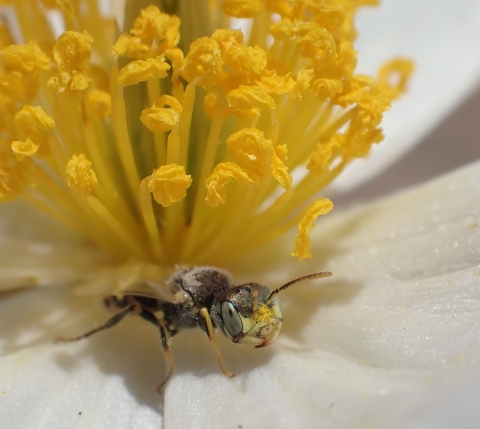
In the sun-scorched sand dunes, gypsum hills and washes of the Mojave Desert, success sometimes comes in packages smaller than a grain of rice.
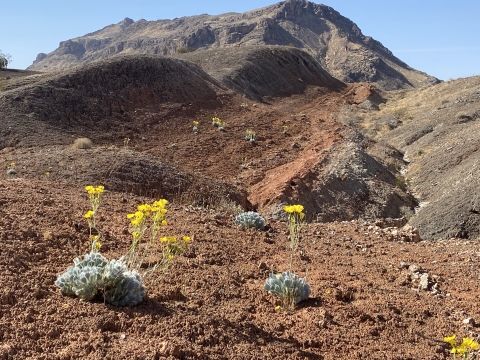
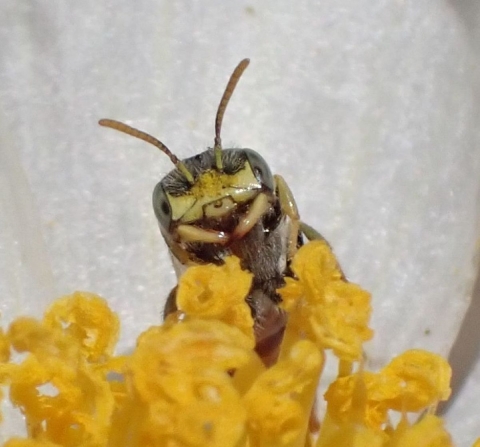
For years, biologists were concerned about the Mojave poppy bee, a solitary, floral-specialist species, found only in a range that is narrower than that of its host plants. Individual bees live just days to a few weeks and their survival depends entirely on the blooming of a few host plants: the Las Vegas bear poppy, and several prickly poppy species – which are somewhat rare and found in patches across parts of the desert.
To gain a deeper understanding of Mojave poppy bee populations and determine if the bee needed protection under the Endangered Species Act, an intensive effort to learn more about the bee and its range was launched by the U.S. Fish and Wildlife Service, the U.S. Department of Agriculture's Agricultural Research Service Pollinating Insects Research Unit and other partners.
"We prioritized historic locations where surveys had not been done for many years, ensuring our efforts addressed areas where the Mojave poppy bee and its host plants may have been overlooked, "said Corey Kallstrom, wildlife biologist from the U.S. Fish and Wildlife Service’s Southern Nevada Fish and Wildlife Office. "This approach was guided by the best available scientific information and aimed to fill critical gaps in our understanding of the species' distribution."

In the United States, the bee was known to live throughout San Bernardino County, California; Mohave County, Arizona; and Clark County, Nevada.
Between 2023 and 2024, that search paid off. Led by USDA's Pollinating Insects Research Unit, the survey teams discovered six previously unknown population groups scattered across the bee's historical range, a dramatic expansion of what scientists thought they knew about the species' distribution and resilience.
Equipped with this new data, along with the best available scientific information on the species, the Service conducted a rigorous analysis of the threats facing the Mojave poppy bee, including urban expansion, mining, habitat fragmentation, trampling, and the ripple effects of variable precipitation on host plants. While the bee did lose one population group along the way in Utah, the broader picture told a different story: multiple resilient populations persisting throughout the Mojave Desert, including the six recently discovered populations.
The Service’s analysis of the best available scientific and commercial data, including this newly gathered population information, led to a determination that the Mojave poppy bee does not meet the definition of threatened or endangered under the Endangered Species Act and does not need to be listed.
This outcome is made possible by proactive science, the kind of on-the-ground survey work that allows the Service and its partners to make confident, data-driven decisions before a species reaches a crisis point. For the Mojave poppy bee, that groundwork revealed a species quietly thriving in what we think of as one of North America's harshest landscapes.